Two Bottles, One Middle Ground: Blending a Gentle CBD Oil With a Stronger One

Photo: two CBD oil bottles dropper teaspoon kitchen counter calm UK, via img.freepik.com
There is a quiet moment in many CBD cupboards. You started with a gentle bottle — perhaps a 5% oil — and later added a stronger one because it was on offer, or because a friend swore by it. Now both sit on the shelf, half-used, and you are wondering whether you can mix them to land somewhere in the middle. Not a chemistry experiment. Just a calmer dose.
The short answer is yes, you can blend two CBD oils for a single serving, provided you know what is in each bottle and you keep the maths simple. But blending is not the only route to a middle strength. Sometimes alternating the bottles is easier, especially if the carrier oils or flavours differ. The useful question is not can I mix these? but what do I actually want one drop to contain?
Start with milligrams, not percentages
UK CBD labels usually show total CBD in milligrams and bottle size in millilitres. A 10ml bottle containing 500mg is 50mg per ml. A 10ml bottle containing 1,000mg is 100mg per ml. Percentages are just another way of saying the same thing, but milligrams are easier to blend on paper.
Drops are less standard. Many droppers deliver around 20 drops per ml, but that is a rough guide, not a law. A thicker oil may form bigger drops; a different pipette may form smaller ones. Check the markings on your own dropper, or count drops into a clean teaspoon once to get a feel for it. If your bottle says 50mg per ml and your dropper gives 20 drops per ml, each drop is roughly 2.5mg. At 100mg per ml, each drop is roughly 5mg. An equal-part blend of those two oils would sit around 75mg per ml, or about 3.75mg per drop.
That last point matters. One drop from each bottle is not a middle drop; it is the sum of both, around 7.5mg. If you want a middle concentration, blend equal volumes in a small clean glass or spoon, then take one drop of the blend. If you simply alternate one drop of low and one drop of high on different days, your weekly average may land in the middle even though each day is not.
The teaspoon test, not the whole bottle
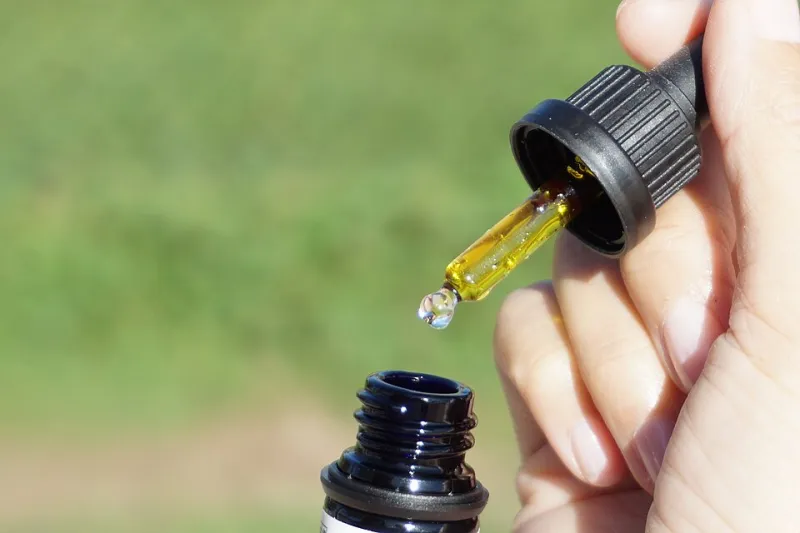
For most people, the simplest approach is a single-serving blend. Put one drop of the gentler oil and one drop of the stronger oil into a clean teaspoon, mix with the tip of the dropper or a clean stirrer, and take it straight away. You have created a small, known dose without committing a whole bottle to an experiment. Do not dip the stronger dropper into the gentler bottle, and do not put a used dropper back into a bottle. Little habits like that keep labels honest.
Blending whole bottles is possible, but it is rarely necessary. If you do it, use bottles with the same carrier oil and a clear label. Work out the final total milligrams and final volume, write the new concentration and date on the bottle, and store it as you would any oil. A blend of two different carriers — say an MCT coconut oil and a hemp-seed oil — may taste fine but can separate or feel inconsistent. It is also harder to trace if you react differently. For a week of testing, a teaspoon is enough.
What the label does not tell you
Strength is only one part of the picture. Two oils at the same milligrams per ml can differ in carrier oil, flavour, and cannabinoid profile. One might be broad-spectrum and another isolate; one might include terpenes, another not. Blending changes the taste and the balance, not just the number. That is not automatically a problem, but it is a reason to change one thing at a time. If you are sensitive to flavour or texture, alternate the bottles instead of mixing them and see which suits you.
Also remember that a dropper is not a laboratory instrument. Half a drop is hard to measure accurately. If you need a smaller step, consider a lower-strength oil, a marked pipette, or a conversation with a pharmacist or your GP rather than trying to split drops by eye. CBD is not a treatment for a medical condition, and if you take prescription medication, are pregnant, or are unsure, get proper advice before changing how much you use.
A seven-day middle-ground diary
Pick one method for the week. Either alternate the bottles — low on Monday, high on Tuesday, low on Wednesday — or make the same equal-part teaspoon blend each evening. Do not change the time of day, the food you take it with, and the blend all at once. That turns a simple test into a puzzle.
Keep the notes small. A line a day is plenty: date, which oil or blend, number of drops, approximate milligrams, time taken, and one word for how the evening or next morning felt. Sleep, steadiness, or simply nothing noticeable are all useful entries. At the end of the week, look for a pattern rather than a dramatic result. If the blended days feel consistent and easy, you have found a workable middle. If they feel fiddly, alternating may be the calmer answer.
The middle ground is not always a perfect half. Sometimes it is a smaller drop of the stronger oil, sometimes it is a low day followed by a high day, and sometimes it is simply a clearer label on the shelf. Two bottles can share a cupboard without sharing a dropper. Start with the maths, keep the serving small, and let the week tell you what your body prefers.